Cirencester is a large town (not a city) in the Gloucestershire Cotswolds, with a population of 20,229 at the 2021 census.
The town lies on the river Churn and is often referred to as the capital of the Cotswolds. Cirencester has a long history, stretching back to Roman times. In those days, the town was known as Corinium and was the second largest in Britain.
Ancient roots
Cirencester is a busy market town and stands on the site of Corinium Dobunnorum, at the crossing of three major Roman roads: Ermin Way, the Fosse Way and Akeman Street.
Founded in about AD75 and planned on a grid of straight lines, the town has seen many archaeological excavations seeking to unearth its Roman history, with a number of the finds on view at the Corinium Museum in Park Street.
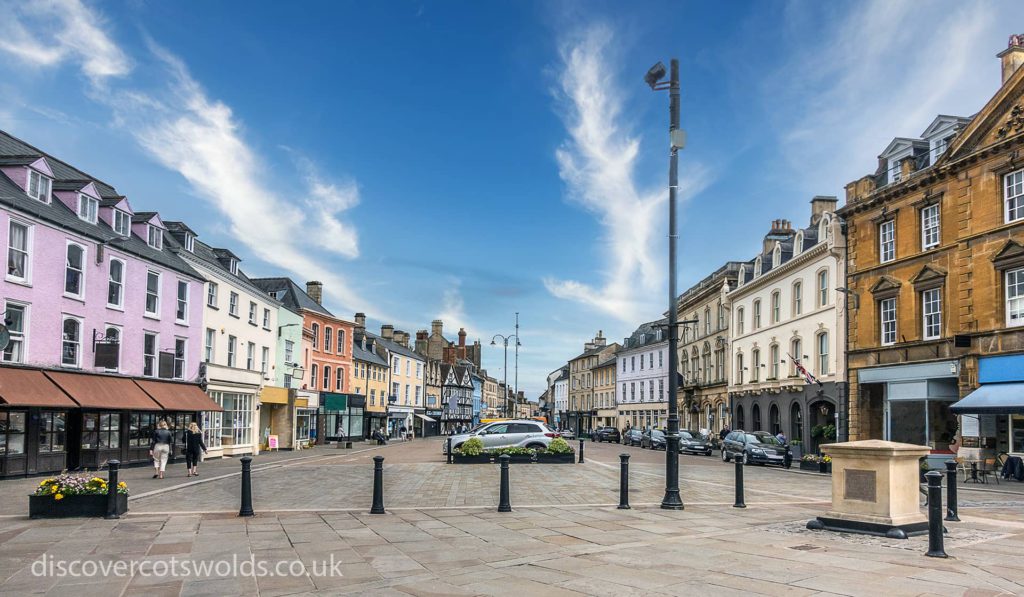
Cirencester’s market town status was mentioned in the Domesday Book of 1086, and it’s a proud tradition that has continued ever since. The Charter Market still runs twice a week in the Market Place.
Located 90 miles west (and slightly north) of London, to the south east of Cheltenham and Gloucester, and the north east of Tetbury, Cirencester is one of the best places in the Cotswolds to get a sense of two thousand years of English history in a single afternoon.
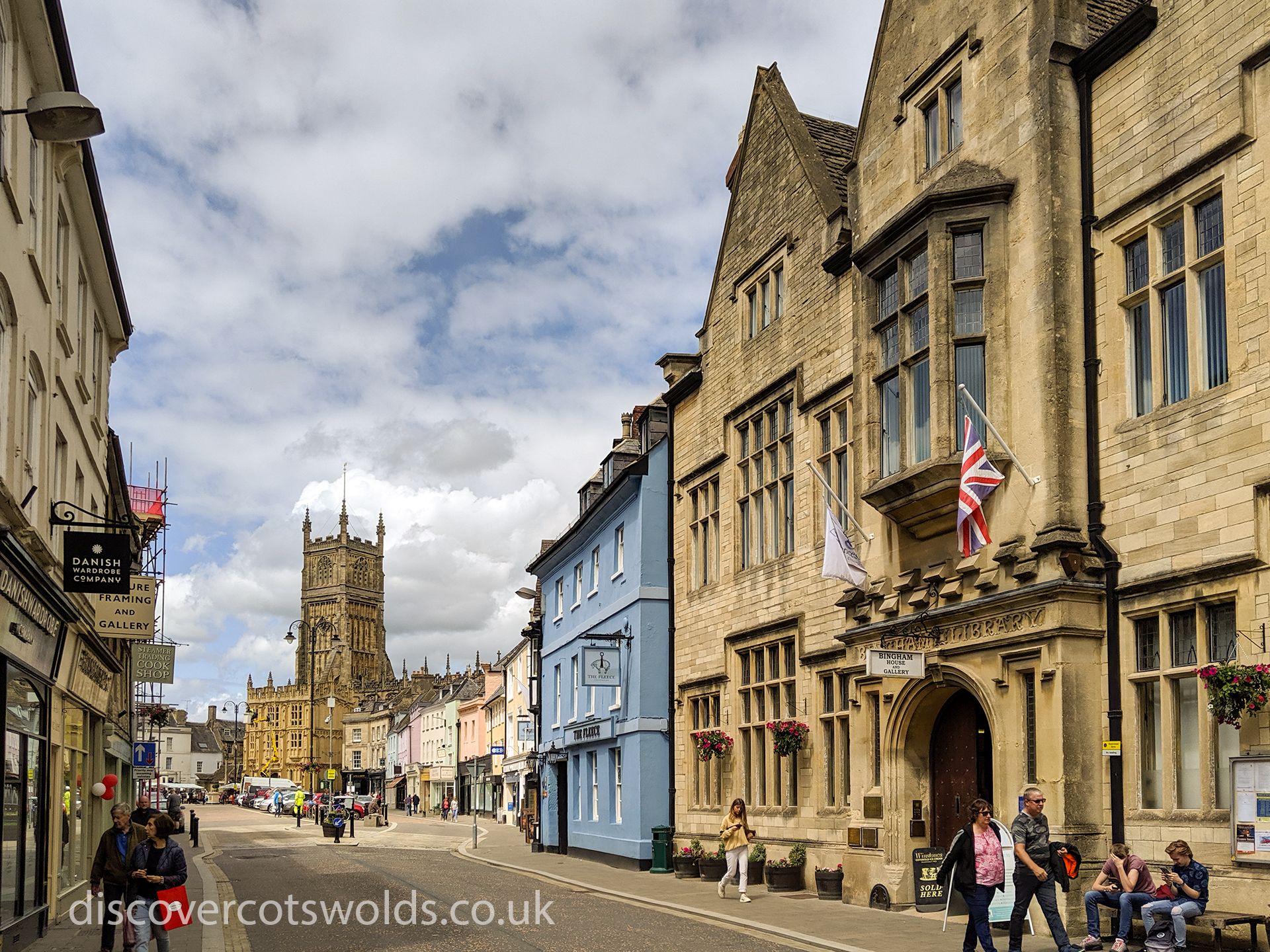
The photo above shows the church of St. John the Baptist, Cirencester, looming over the market square.
Things to do in Cirencester
Corinium Museum
On passing through the main door of the Corinium Museum, visitors are transported back to Roman Britain and its second largest settlement, Corinium. You can see some of the stunning mosaics discovered throughout the town and look through windows into the rooms of a Roman villa.
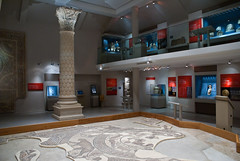
Image Source: https://farm4.staticflickr.com/3453/3390060859_dcdb05b1f4_m.jpg
Image Courtesy: https://www.flickr.com/photos/stanbury/3390060859/
Once through the Roman galleries you will come face to face with the Anglo-Saxons, with a gallery built around the treasures uncovered at the Butler’s Field cemetery at Lechlade. There are also prehistoric artefacts and displays of Victorian life in the town.
The museum is on Park Street and is open daily year round (Sunday afternoons only), closing just for Christmas and New Year’s Day. An entrance fee is charged.
St John the Baptist church
Often called the Cathedral of the Cotswolds, St John the Baptist dominates the Market Place and is one of the largest parish churches in England. It’s the grandest of the Cotswold wool churches, built on the wealth of the town’s medieval wool merchants.
The tower was built around 1400-1420, funded by Henry IV as thanks for the town’s support against a rebellion of the earls. The magnificent three-storey south porch facing the Market Place later served as the Town Hall.
Cirencester Park
Cirencester Park is the landscaped western half of the Bathurst Estate, with its sweeping Broad Avenue and geometric rides laid out in the early 18th century with input from the poet Alexander Pope. Opposite the Corinium Museum you can see the estate’s famous yew hedge, reputed to be the tallest in the world.
Note that entry to the park now requires a pass. Day visitors can buy a day pass online or at the ticket offices at the Cecily Hill and Windsor Walk entrances; the park is open to day visitors from 10am to 5pm, with last entry at 4.30pm. Check the Bathurst Estate website for current arrangements before you visit.
The Roman amphitheatre
On the south-western edge of town lies one of the largest Roman amphitheatres in Britain, believed to have held up to 8,000 spectators. Only partially excavated, it survives as a grassed earthwork, and walking the banks gives a real sense of its scale. It’s a scheduled ancient monument in the care of English Heritage, with open access.
The Abbey Grounds
Behind the parish church, the Abbey Grounds park marks the site of Cirencester’s great Augustinian abbey, founded in 1117 and demolished at the Dissolution. The 12th century Norman Arch is the only part left standing, and a stretch of the Roman town wall survives by the footbridge. It’s a lovely spot for a picnic between sights.
New Brewery Arts
New Brewery Arts is a craft centre in the heart of town with resident makers’ studios, a gallery, shop and cafe, and runs classes in pottery, wood turning and other crafts if you fancy making something rather than just buying it.
The markets
The Charter Market runs every Monday and Friday in the Market Place, continuing a tradition recorded in the Domesday Book. A Farmers’ Market joins it on the second and fourth Saturday of each month. Between them and the town’s independent shops, galleries and antiques dealers, Cirencester is one of the best shopping towns in the Cotswolds.
Before Christmas the town adds an Advent Market and gift markets. Dates are in our guide to Christmas in the Cotswolds.
Cirencester Town Walk
Leave the Market Place via Castle Street passing the Post Office and turning into Silver Street and then into Park Street to pass the Corinium Museum on the right. The museum houses some beautiful Roman remains including several mosaic pavements including the Orpheus Pavement found at nearby Barton Farm.
Opposite the museum a good view of the huge yew hedge can be seen. This is reputed to be the tallest in the world and forms part of the boundary of Cirencester Park.
Continue past the museum turning left entering Cecily Hill, the guide books say that this is the limit of the original town. Many of the houses lining the street are from the 18th and 19th centuries. The Barracks at the top of the hill, built in 1857 was the HQ for the Royal North Gloucestershire Militia. Cecily Hill is a cul de sac; the gates at the end are one of the ticketed entrances to Cirencester Park (see above).
Return along Cecily Hill and turn left to enter Thomas Street and then right into Coxwell Street. Properties along here saw action in 1642 during the English Civil War.
Turn left into Dollar Street, named after the Dole Hall of the Abbey. A property on the left has two rather splendid statues high above the ground decorating the frontage. Take the second turning on the left, just past the bakers and continue along the passageway to Thomas Street, turn right and continue along the street passing the former Friends Meeting House and the restored Temperance Hall, used by the Salvation Army. Further on the left is the oldest building in the town, the Almshouses of St Thomas’s Hospital founded in 1483.
Cross over Dollar Street and turn right into Spitalgate Lane. On the left is St Johns Hospital and Chantry founded by Henry II and the Almshouses next door. Continue for a short distance along Spitalgate Lane turning right into Dugdale Road to enter the Abbey Grounds.
The only standing part of the former Abbey, a Norman Arch, built in the 12th century is a few yards to the left of the pathway. Continue along the pathway towards Cirencester parish church passing the site of the Abbey Church of St Mary marked out on the lawns by pathing. Turn left and follow the pathway through the park over a small footbridge to see the remaining old town Wall.
Leave the park over the footbridge and left into Corinium Gate and continue to the main road. Turn right and at the traffic lights turn left to follow Victoria Road. Continue along Victoria Road to Chester Street on the right. Turn along here. Properties along the street hide ancient remains and a mosaic was discovered by Channel 4’s Time Team during excavations here in 1999.
Turn left at the end of the road and left into St Michaels Park. Continue through the park with a good view of the parish church of Watermoor. On leaving the park note Bingham Hall before turning right to reach Watermoor Road.
Turn right to go along Watermoor Road and turning right into The Avenue. Turn left to reach the crossing of Ermin Way and the Fosse Way and enter South Way and the Forum area of the old town. Continue past the police station and the Bear Hotel turning left into the Market Place and return to the parish church.
Getting to Cirencester
By road, Cirencester sits at the junctions of the A429, A419 and A417, north of Swindon and about 90 miles from London.
The nearest railway station is Kemble, around 15 minutes’ drive to the south, with direct GWR trains from London Paddington taking around 80 minutes. A taxi or bus connects Kemble to the town centre.
Bristol airport is around 60 miles away to the south west and Oxford airport 35 miles to the east.
For public transport options across the region, see our guide to the Cotswolds without a car.
Four miles north east, on the road towards Bibury, the village of Barnsley is worth the short drive for the garden Rosemary Verey made famous, now part of THE PIG in the Cotswolds.
Places to stay
There are several cottages, hotels and bed and breakfasts in Cirencester town centre and further afield.
Find places to stay in Cirencester here.
If you enjoy camping, there are some camp sites nearby that offer spaces for tents as well as caravans.
Cirencester FAQs
What is the population of Cirencester?
Cirencester had a population of 20,229 at the 2021 census, making it one of the largest towns in the Cotswolds.
Is Cirencester a city?
No. Despite its size, history and nickname of “capital of the Cotswolds”, Cirencester is a market town, not a city.
What county is Cirencester in?
Cirencester is in Gloucestershire, in the south east of the county between Cheltenham and Swindon.
Why is Cirencester called the capital of the Cotswolds?
It’s the largest town in the Cotswolds and has been the area’s main market centre since Roman times, when Corinium was the second largest town in Britain. No official title, but nobody seriously disputes it.
What day is market day in Cirencester?
The Charter Market runs every Monday and Friday in the Market Place, with a Farmers’ Market on the second and fourth Saturday of each month.
See more Cotswold market towns.