Blockley is one of the larger villages in the north Cotswolds, strung out for about a mile along the Blockley Brook between Moreton-in-Marsh and Chipping Campden. The cottages sit one behind the other up the side of the valley, and the brook below them used to drive a string of silk mills. These days the village is better known as Kembleford, Father Brown’s parish on BBC One.
It’s spelt Blockley, although Blokley, Blockely and even Bloxley all get typed into search engines.

Where is Blockley?
Blockley is in Gloucestershire, about four miles by road north-west of Moreton-in-Marsh, in the Cotswold District Council area. It hasn’t always been in Gloucestershire. Until 1931 the parish was a detached piece of Worcestershire, an island of one county surrounded by Gloucestershire and a sliver of Warwickshire. The bishops of Worcester had held it since 855, when King Burgred of Mercia sold them the monastery here for 300 silver solidi, & apart from a spell after the Civil War, when Parliament sold the manor off, they kept it for centuries.
The parish also takes in the hamlets of Aston Magna, Dorn, Draycott and Paxford.
Is Blockley worth a visit?
If you watch Father Brown, the church and the vicarage are reason enough. If you walk, the Heart of England Way runs through the village and Batsford Arboretum is within walking distance along it. If you like a village with an industrial history, the mills along the brook are the story. For food and drink there’s a village shop, a café and two pubs.
The silk mills on Blockley Brook
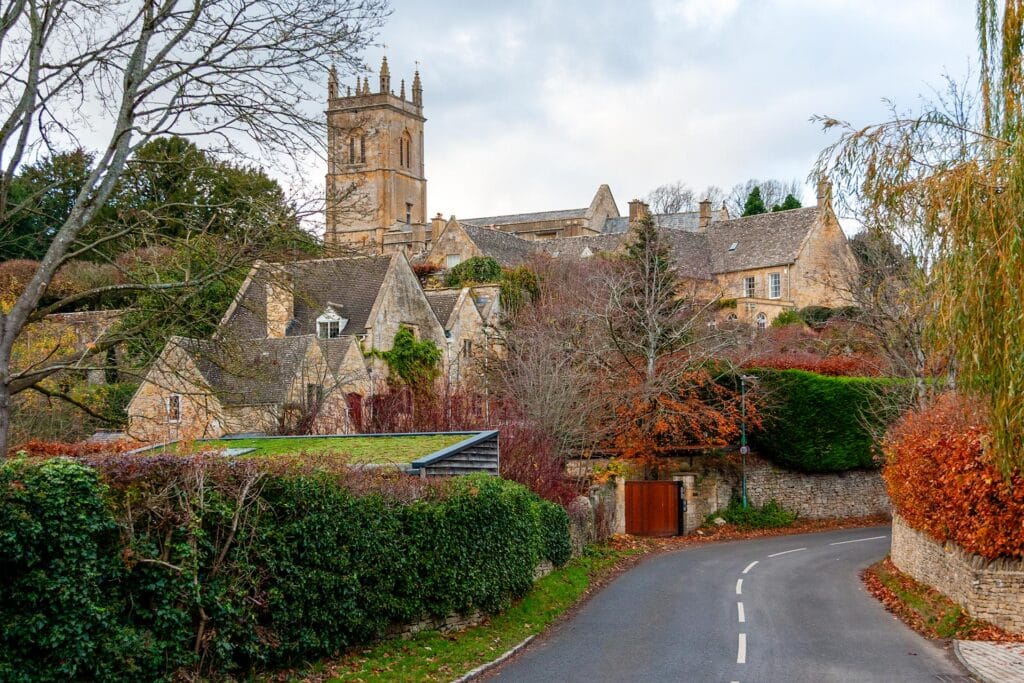
Mills on the brook go back a long way. The Bishop of Worcester’s survey of 1299 already records a fulling mill here, for finishing woollen cloth. Silk came later. The first silk mill went up around 1700, and by 1827 there were eight. They threw silk, twisting the raw fibre into thread, and the thread was sold in Coventry and London.
Free trade finished it. A treaty with France in 1860 let French silk into Britain duty free, and by the 1870s Blockley’s mills had gone back to flour, flax, cider, woodcutting and threshing.
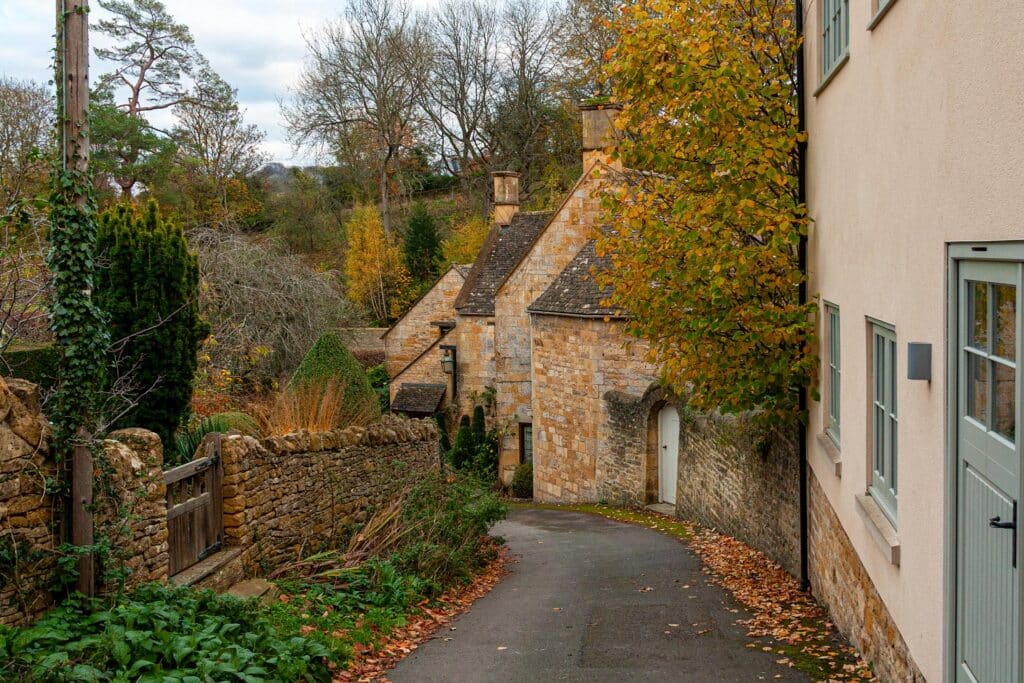
For most of their working lives the mills had no names of their own. Each one was known by whoever happened to be the miller at the time, and names like Malvern Mill only arrived when the buildings became houses, around 1930. Most of them are still private homes, and a few of their gardens open on the National Garden Scheme days (see below).
The parish does still make something. Watsonian Squire has built motorcycle sidecars at the Northwick Business Centre since the 1980s, on an estate that started out as a field hospital built ahead of D-Day.
Blockley and Father Brown
The Church of St Peter and St Paul is Norman, built around 1180 for the bishops of Worcester. It’s Church of England. In Father Brown it’s St Mary’s, the Roman Catholic church in Kembleford. The vicarage next door plays Father Brown’s presbytery from the outside; the interiors were filmed in the old hospital at Moreton-in-Marsh.
The BBC first filmed here in 2012. For one Christmas episode the crew covered half the churchyard in fake snow and shot a nativity scene in 22 degree heat.
Other villages used in the series include Guiting Power, Winchcombe and Upper Slaughter. If you want every Blockley location, Brit Movie Tours runs a 90-minute Father Brown walk around the village.

Blockley’s open gardens
Blockley has been opening its private gardens for the National Garden Scheme since the 1920s. On the group open days several gardens open together, including mill gardens on the brook such as Snugborough Mill and the Old Silk Mill. The dates change each year, so check the NGS listing for Blockley before you go. Some of the gardens are steep, and dogs aren’t allowed.
Walking from Blockley
The Heart of England Way, the long-distance path from Cannock Chase to Bourton-on-the-Water, comes through Blockley on its way from Broad Campden to Bourton-on-the-Hill. Between Blockley and Bourton-on-the-Hill it shares the path with the Monarch’s Way past Batsford Arboretum, so you can walk out to the arboretum, carry on to Bourton-on-the-Hill for the pub and come back. Coming the other way from Batsford, the path crosses the fields towards Blockley’s church.
Batsford Arboretum and the falconry centre
Batsford Arboretum is the obvious add-on, between Blockley and Moreton. It covers 55 acres, with a garden centre and the Garden Terrace Café, and dogs are welcome. The Cotswold Falconry Centre is right next to it, but it shuts for the winter from mid-November to mid-February and doesn’t allow dogs.
Eating and drinking in Blockley
Blockley Village Shop and Café is on Bell Lane. The building was paid for by the village with help from the National Lottery and opened in 2008, and the shop and the café are now run as two separate businesses.
There are free to use public conveniences next to the shop and cafe, by the entrance to the church yard.

The Great Western Arms on Station Road is a Hook Norton pub, named after the railway. Blockley’s own station was a mile and a half out of the village towards Paxford, and it’s long gone.
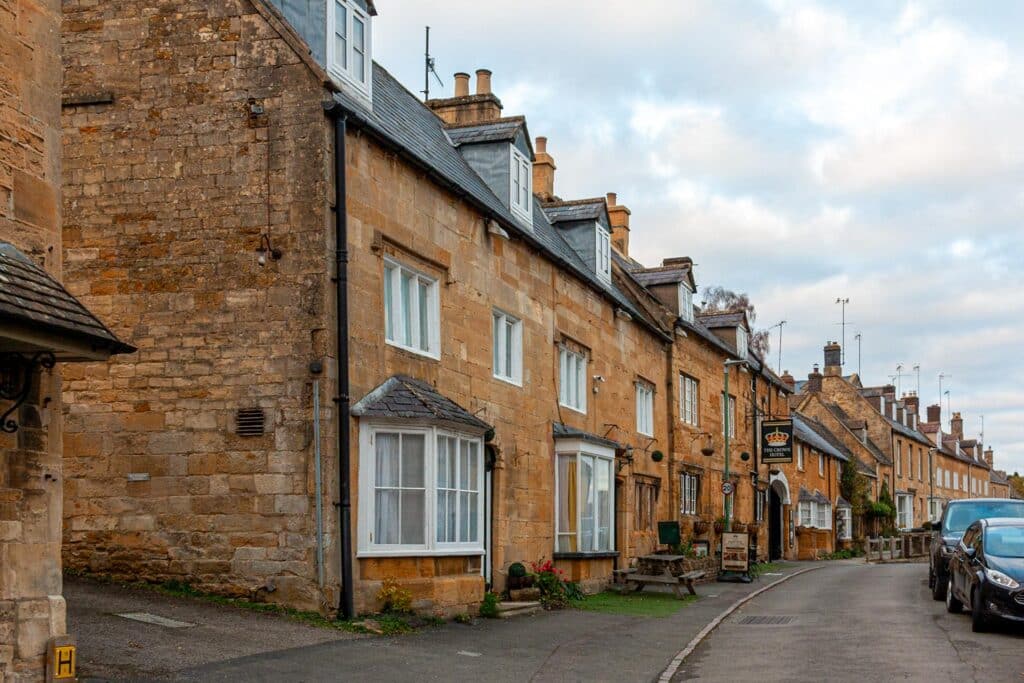
The Crown on the High Street is the other one, a former coaching inn, in a building from around 1700, now a hotel with a bar and restaurant.
Getting to Blockley
By car, turn off the A44 at Bourton-on-the-Hill onto the B4479, or come from Chipping Campden through Broad Campden and up the hill into the village.
If you’re visiting without a car, the nearest station is Moreton-in-Marsh, with direct trains from London Paddington. Stagecoach buses 1 and 2 run from Moreton station through Blockley to Chipping Campden a few times a day, and the 1 runs on Sundays too; check current times before you travel. Our guide to the Cotswolds without a car covers the rest.
See more Cotswold villages.