Chipping Norton, or Chippy as everyone local calls it, is the highest town in Oxfordshire and sits in the eastern Cotswolds, where the hills start to flatten out towards Oxford. It is in West Oxfordshire, 18 miles north-west of Oxford and 12 south-west of Banbury, and just under 7,000 people live here.
It’s a proper working market town rather than a chocolate-box village, and is all the better for it: independent shops, a grand market square, a wool-money church and one of the most-loved small theatres in the country, all built from the same honey-coloured stone as the prettier places to the west.
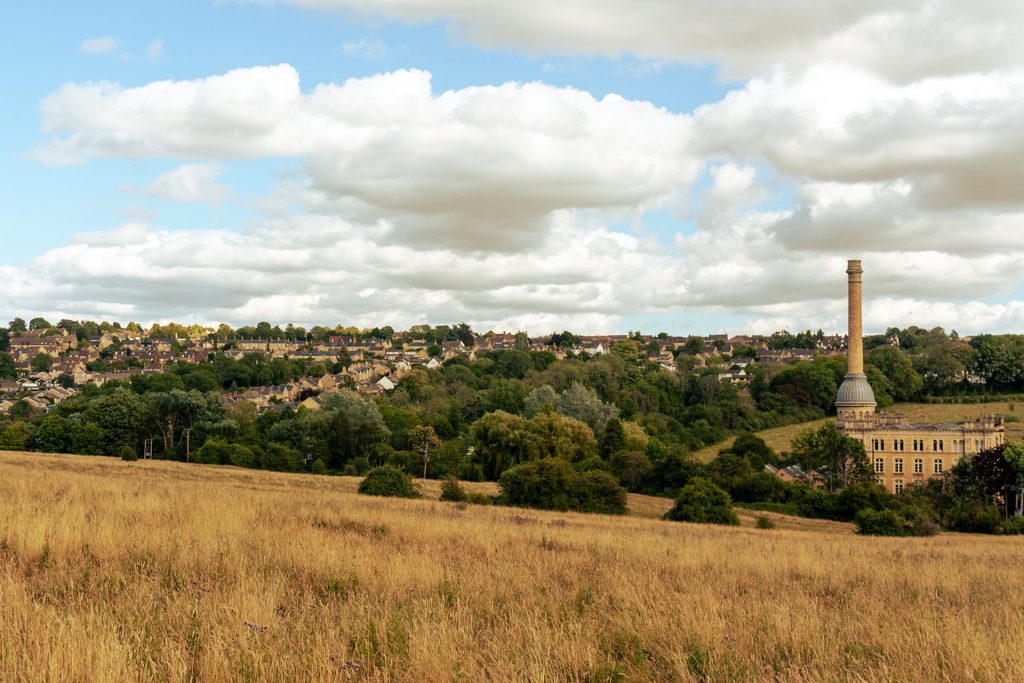
It also has one of the odder origin stories in the Cotswolds. The town moved up the hill.
The town that moved up the hill
Chipping Norton started life down in the valley of the River Glyme, clustered around a Norman castle whose earthworks you can still make out below the church. At some point in the Middle Ages the town picked itself up and moved uphill, where the local lord laid out a huge market square, bigger than the space it occupies now, to pull in trade.
“Chipping” comes from the Old English for a market, and the market is the reason the town exists. Houses went up around the market space, and the long, narrow alleyways that still run behind the High Street are the giveaway.
These were burgage plots: slim strips of land that gave every trader a shop front onto the square. It is often said the arrangement is where the phrase “window shopping” comes from, which may be more good story than settled fact, but it fits a town that has always been built around selling things.
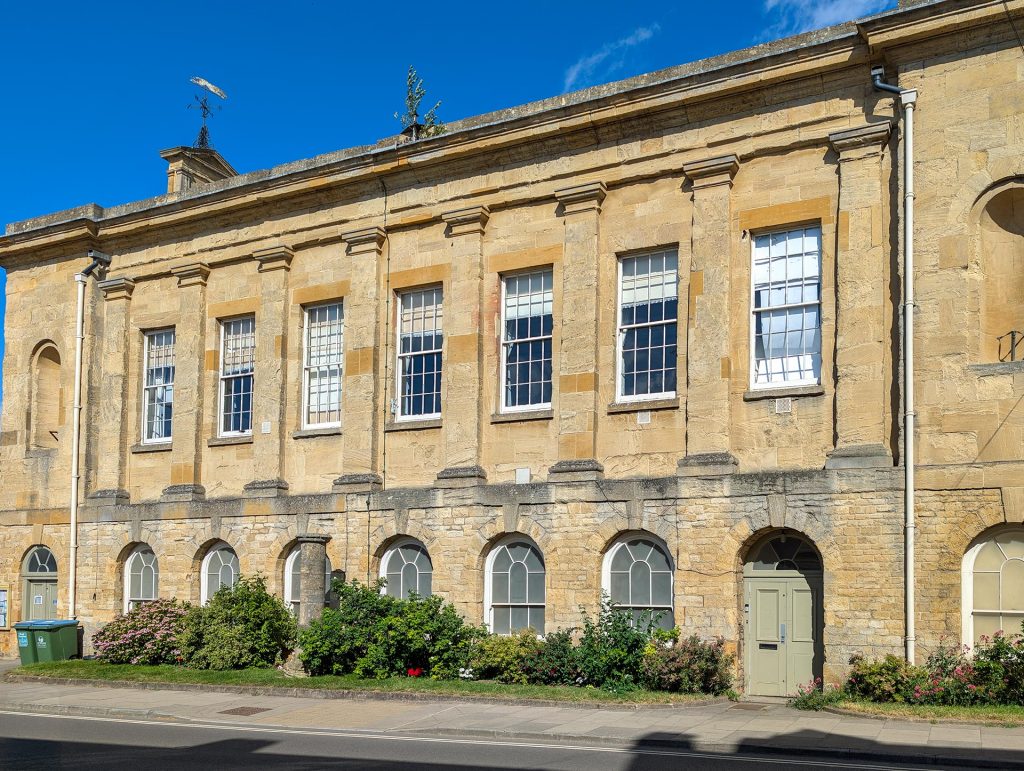
Look up as you walk the square and you will see a lot of smooth, symmetrical, almost stately stone frontages. Many of the medieval buildings were given a facelift after 1704, when Blenheim Palace was rising a few miles down the road and its grand baroque style became the fashionable thing to copy.
Bliss Mill
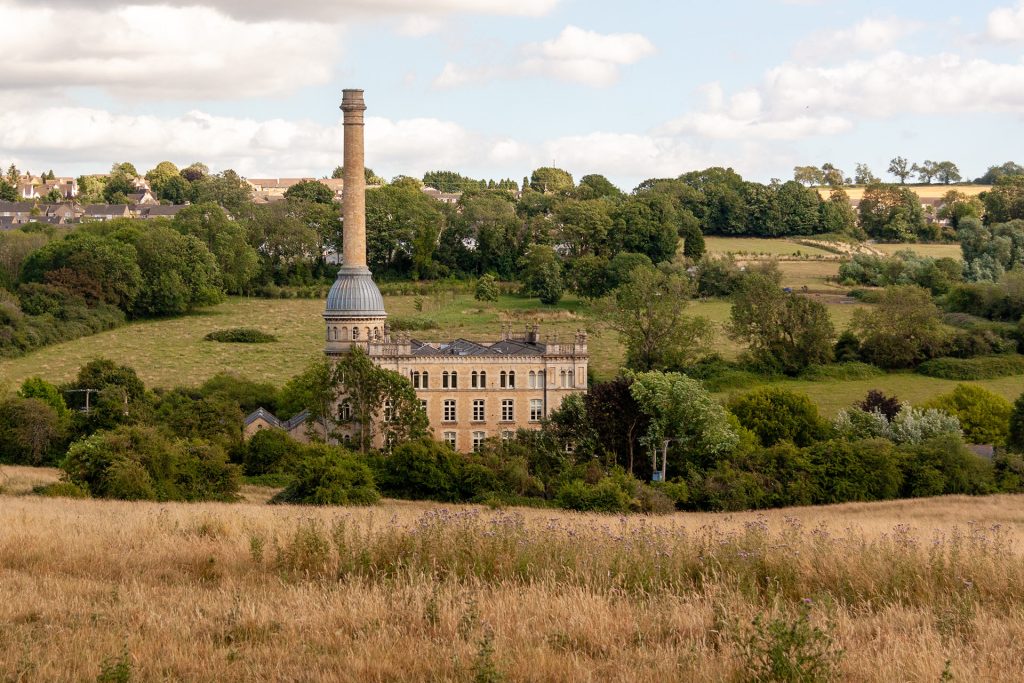
The one building everyone photographs is not in the town at all, but just below it. Bliss Mill looks like a stately home dropped into a fold of the hills, with a domed tower and a tall chimney rising out of it. It was in fact a tweed factory.
It was built in 1872 for the Bliss family, who ran the town’s cloth trade, and it kept making high-quality tweed until 1980. The architect, George Woodhouse, gave it that grand country-house look on purpose. It is now Grade II listed and converted into apartments, and the domed chimney tower is the signature you see on every postcard of the town. Locals have long said the chimney looks less like a stately home and more like a sink plunger, which is the kind of thing only a place as unsentimental as Chippy would say about its own landmark.
The mill also gave the town a place in trade-union history. After the Bliss family sold up in 1895, the new owners cut wages and resisted the growing workers’ rights movement, and the strike that followed became one of the town’s famously regular flare-ups. Chipping Norton has never been a sleepy place.
St Mary’s, the wool church
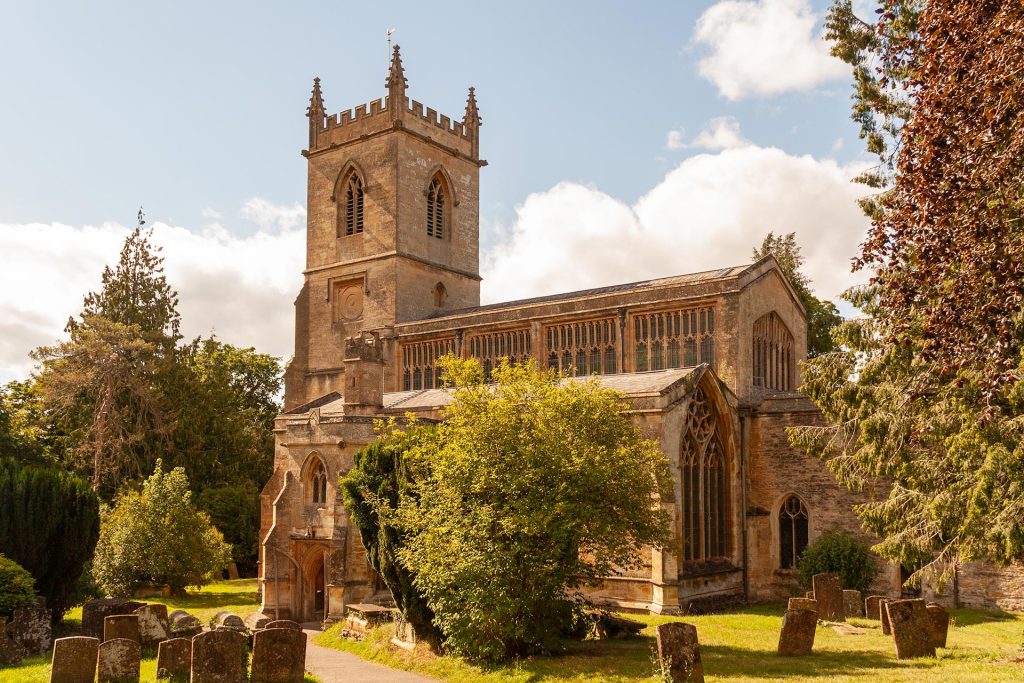
Wool made the medieval Cotswolds one of the richest corners of England, and the wealth is written into St Mary’s. The nave was largely rebuilt in the late fifteenth century, with a soaring row of Perpendicular Gothic windows, paid for by a wool merchant called John Ashfield. Churches funded this way are known as wool churches, and St Mary’s is one of the finest, with parts of the older building going back to the twelfth and thirteenth centuries. It stands on the hill beside the site of that first Norman castle.
The Cornish almshouses
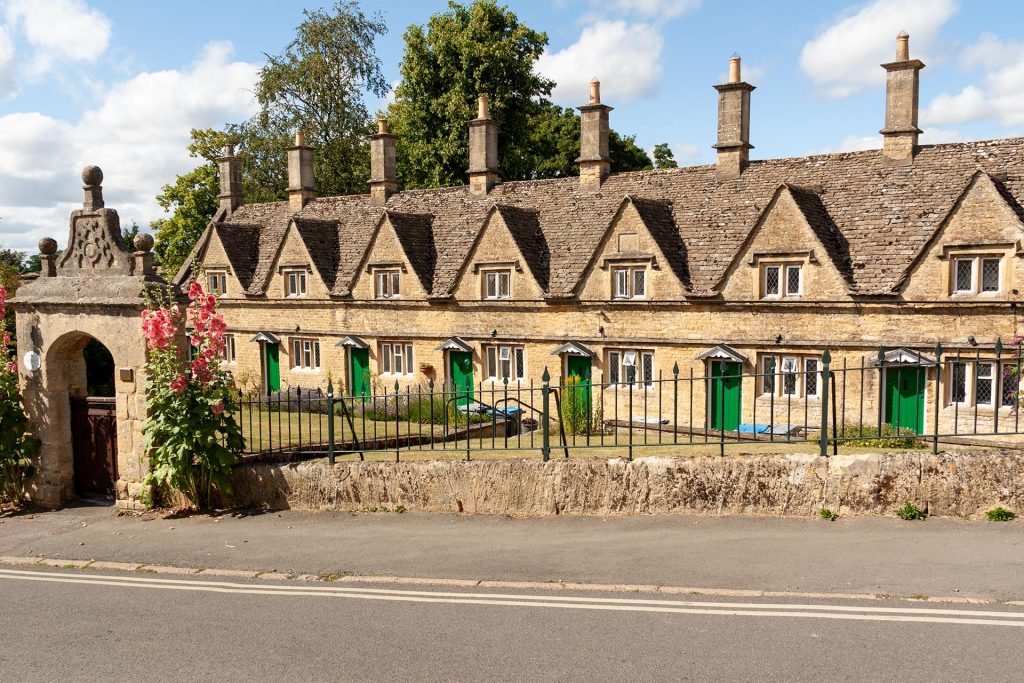
Just above the church on Church Street is a low, handsome row of almshouses that most visitors walk straight past. They are worth a look. An inscription records them as “the work and gift of Henry Cornish, gent”, who founded them in 1640 to house eight poor widows of the town. Cornish was one of the first members of the town corporation, and the almshouses are best seen through the stone archway that frames them from the street, which is one of the most photogenic and least photographed corners of Chippy.
The Theatre
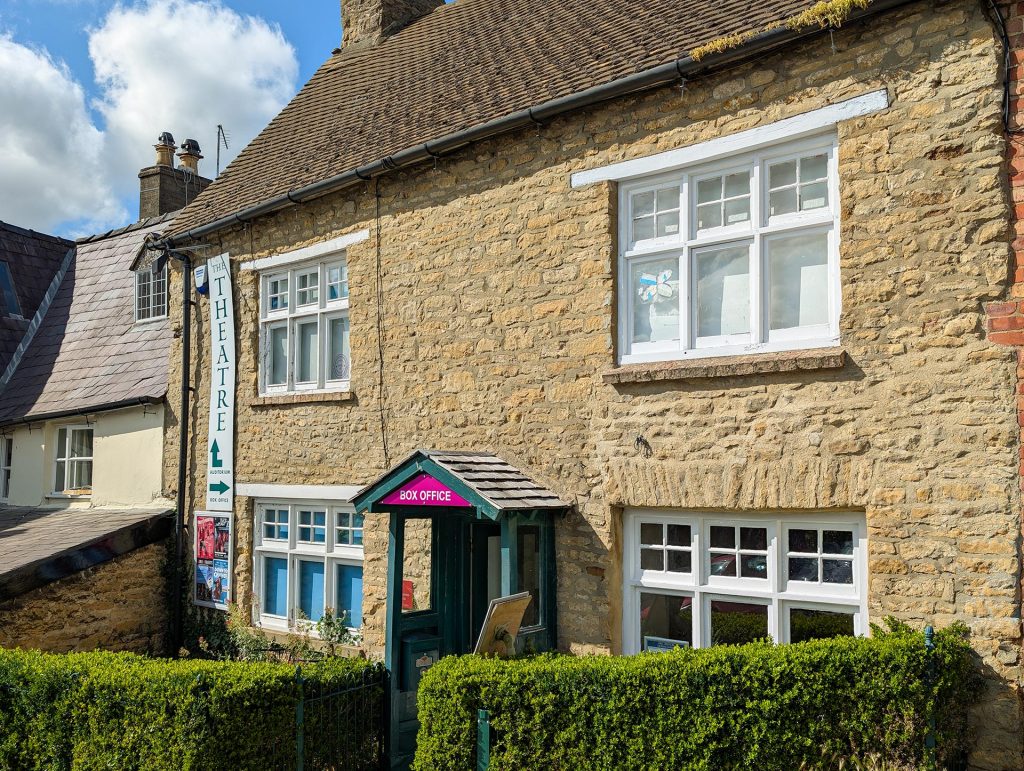
For a town of this size, Chipping Norton has an out-sized cultural life, and the Theatre is the heart of it. It lives in a former Salvation Army Citadel of 1888, which spent some years as a furniture warehouse before two Royal Shakespeare Company actors bought it and opened it as a theatre in 1975. With just 217 seats it is one of the smallest producing theatres in the country, and it packs in drama, music, film and children’s shows. Its annual pantomime is one of the best in England, so if you are visiting around Christmas, book early. Oh yes you should.
A surprising streak of rock and roll
Chippy had a recording studio from 1972 to 1997, and a remarkable run of hits came out of it, from the Bay City Rollers’ “Bye Bye Baby” to Kajagoogoo’s “Too Shy” and Gerry Rafferty’s “Baker Street”. The town’s musical connections run deeper than that: the town once had around twenty coaching inns, and when the railways took the coach trade away many became pubs. Keith Moon, the drummer with The Who, briefly owned one of them from 1970. It is not a history you would guess from the quiet stone streets.
Things to do in Chipping Norton
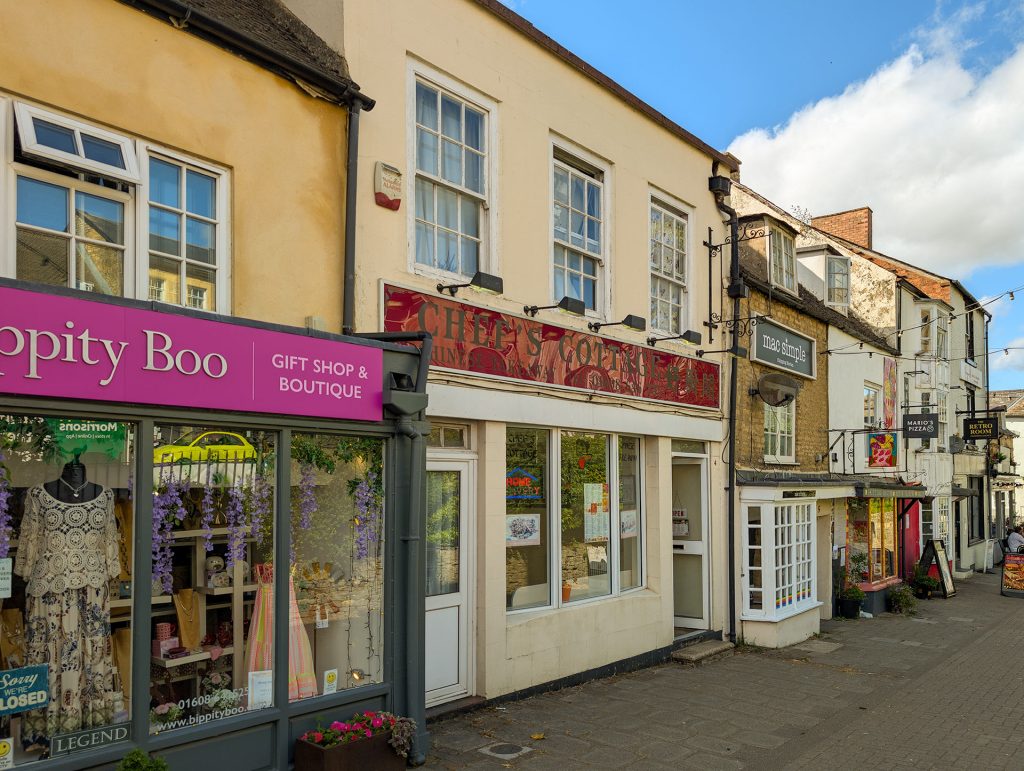
The pleasure of Chippy is mostly in wandering it. Spend an hour on the Market Place, look up at the neoclassical Town Hall of the 1840s, walk the burgage alleyways, climb up to St Mary’s and the almshouses, and browse the independent shops, delis and pubs that fill the square and the side streets. It is a genuine working town, so it feels lived-in rather than staged.
Market day is Wednesday, when the market fills the Market Place from around 9am. Check what’s on at the Theatre while you are planning. If you’re here in winter the pantomime is worth building a trip around.
The town also makes a good base for the northern Cotswolds. The Rollright Stones, an ancient stone circle wrapped in folklore, are a short drive north, and Moreton-in-Marsh, Stow-on-the-Wold and the village of Long Compton are all within easy reach.
Chippy is probably a better base than a destination. Give it a couple of hours on foot rather
than a day, then use it for the somewhere to sleep, the food and the shops while you head out to the villages and other sights nearby.
Getting to Chipping Norton
By car: Chipping Norton sits where the A44 and A361 meet, about 20 miles north-west of Oxford. There are several free car parks in and around the centre, including New Street and Albion Street, plus short-stay spaces on the Market Place. Signage sets the time limits, so check before you leave the car, and note that on Wednesdays part of the square is given over to the market.
By train: the nearest station is Kingham, about five miles away, on the London Paddington to Worcester line. The town’s own station closed in the 1960s. From Kingham there are buses and taxis into Chippy, and buses also run from Oxford and the surrounding towns. For the full picture, see our guide to getting to the Cotswolds and to visiting the Cotswolds without a car.
Public Conveniences
There are public toilets in the New Street car park (entrance opposite Sainsbury’s car park). Whilst the car park is free, there is a charge for using the toilets. It’s currently 20p and unlike many other facilities in the Cotswolds, it only takes coins, so make sure you have some change at the ready.
Where to stay
Chipping Norton makes an easy base for the northern Cotswolds, with everything from town-centre inns to country hotels and B&Bs within a short drive. For ideas across the region, see our guides to the best Cotswolds B&Bs and luxury hotels in the Cotswolds, or browse places to stay in the Cotswolds.
Check availability for places to stay in Chipping Norton.
Nearby
Chipping Norton is a natural gateway to the northern Cotswolds. Read more about the Cotswolds or explore the other Cotswold towns.
Some links on this page are affiliate links. If you book through them, we may earn a commission at no extra cost to you.