Castle Combe is a small village in north Wiltshire, in the southern Cotswolds, about five miles north west of Chippenham.
In 1962 it was voted the prettiest village in England by a national newspaper, and it has been trading on the title ever since. Around 60 people live in the village centre. On a summer Saturday there will be a great many more than that standing in it.
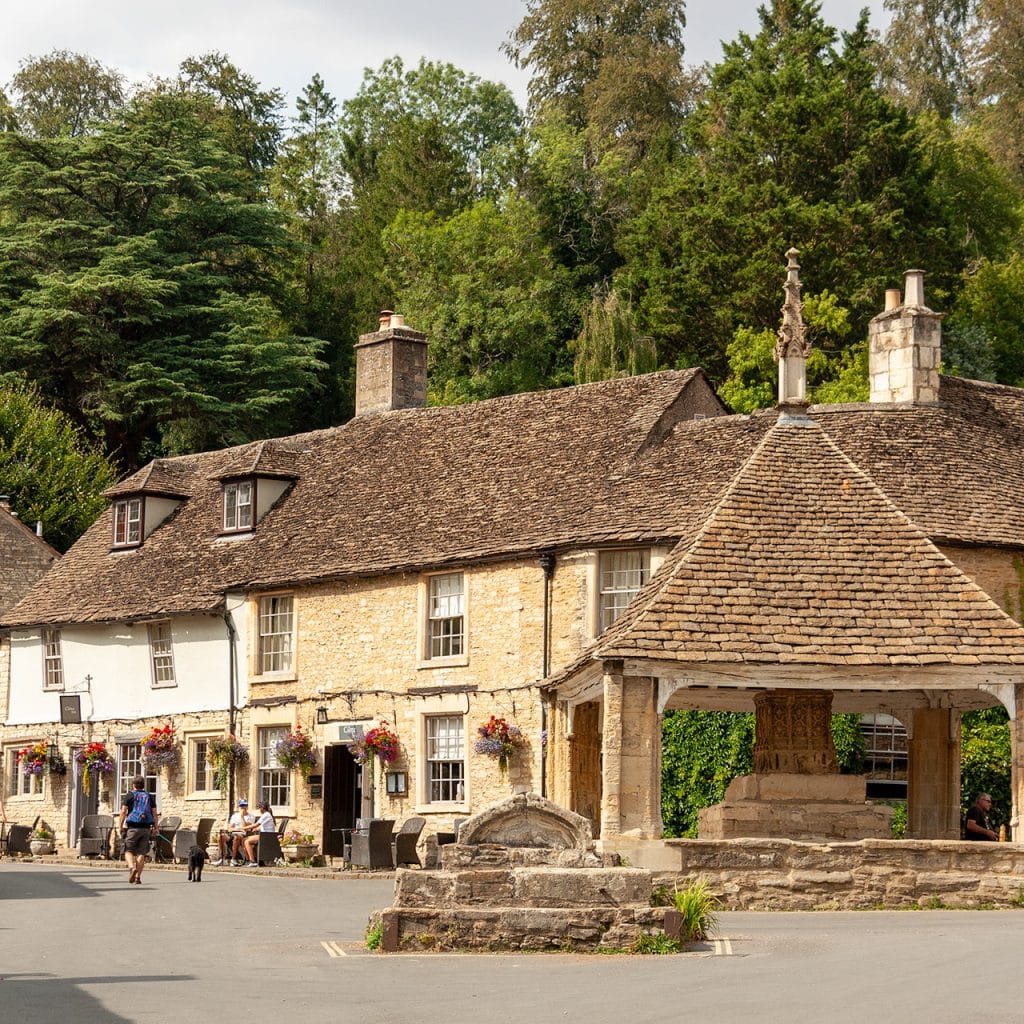
The parish council is unusually straight about what the village is. Its own website says the average visit lasts “just over one hour”, that there are “no rows of gift or souvenir shops in the tiny main street”, and that Castle Combe “is not an all-day destination”. That is worth reading before you set off, because a lot of people arrive expecting a day out and find a street, a church, a bridge and a brook.
It’s true, there really isn’t much to do in the village, as one infamous Tripadvisor review left by an American tourist complained. In fact, it might take you longer to walk back to the car park than it does to see all of the sights in the village.
What it does have, and this is the bit the parish rather undersells, is somewhere to eat. Two pubs, a coffee shop, a picnic shop and a Michelin-starred restaurant, in a village of sixty people. Book a table and the one-hour visit becomes a decent half day.
Castle Combe is also one place where it’s useful to have some cash on you. Some of the cottages sell things from their own front doors: ice creams, water, coffee. One of them does Marshfield Farm ice cream, served out of the doorway by the woman who lives there, and she doesn’t take cards.
Why the village looks the way it does
Castle Combe made its money from wool. In the fourteenth and fifteenth centuries this was one of the more prosperous cloth villages in the Cotswolds, and the By Brook running through the valley powered the fulling mills that finished the cloth. The weavers here are said to have produced a red-and-white broadcloth that sold across Europe.
Then the cloth trade moved on, and the money went with it. Nobody had a reason to knock anything down and build something better, so nothing was knocked down. The village you walk into is a medieval wool village that stopped.
Things to do in Castle Combe
The Market Cross
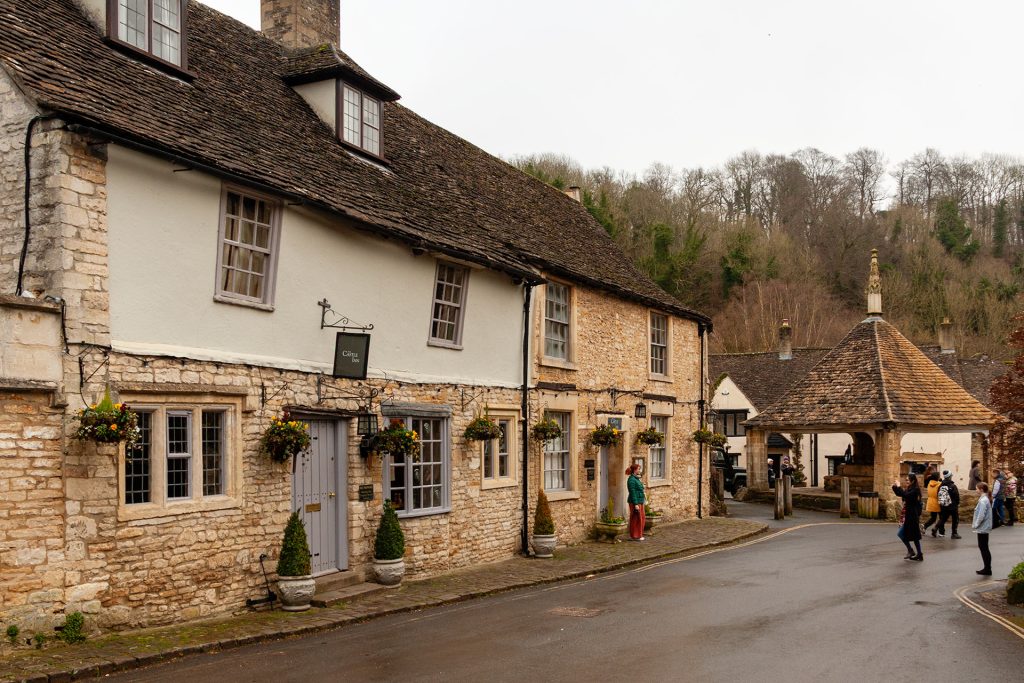
The Market Cross stands where the three main streets of the lower village meet, which is why everyone ends up at it. It is fourteenth century, put up when Castle Combe was granted the right to hold a weekly market, and it is a scheduled monument rather than a listed building. Historic England’s entry says it reflects “the significance of the cloth industry in this area”.
Two things beside it are worth ten seconds each. One of the village’s two pumps stands next to the cross. The small stone steps close by are a mounting block, for getting onto a horse. The stub of masonry near them is the buttercross, also called Weavers’ Steps, built in the late nineteenth century out of old stone and a scheduled monument in its own right.
The market itself is long gone. There is still a Castle Combe market, but it runs in the village hall on selected dates.
I dropped the 1440 Henry VI charter I mentioned earlier. That came from one blog and it can’t be right alongside a fourteenth-century cross. Same blog also had the buttercross backwards: it was built in the 1800s from old masonry, not dismantled.
St Andrew’s church and the faceless clock
St Andrew’s is Grade I listed and mostly fifteenth century, with thirteenth century work surviving in the chancel. The west tower was begun in 1434 and paid for by the local clothiers, which tells you where the money in this village sat.
Inside the Lady Chapel there is a late Norman effigy of Walter de Dunstanville, Baron of Castle Combe, who died in 1270. His legs are crossed, which by convention marks him as a crusader.
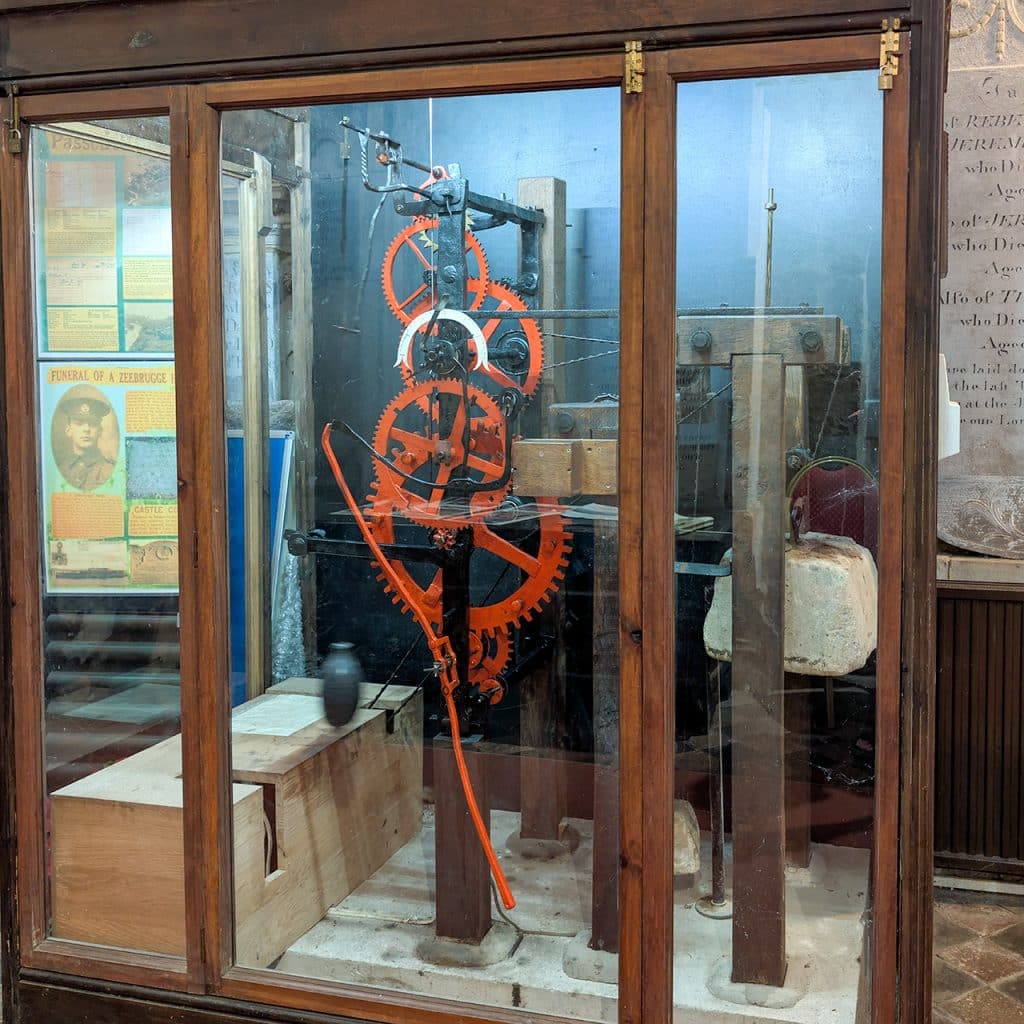
The thing most people miss is the clock. It has no face. It was probably built in the late fifteenth century and it is claimed to be the oldest medieval clock still working in England, a claim a few other churches also make. Sometime after 1670 it was converted from a foliot to a pendulum, which meant turning the entire mechanism upside down and rebuilding the striking release so gravity worked the right way. In 1984 it was taken down out of the bell tower, set on a plinth inside the church in a wooden cabinet with glass panes, and its moving parts were painted bright orange. It still strikes the bell up in the tower.
There are 25 listed tombs in the churchyard.
The By Brook and the bridge
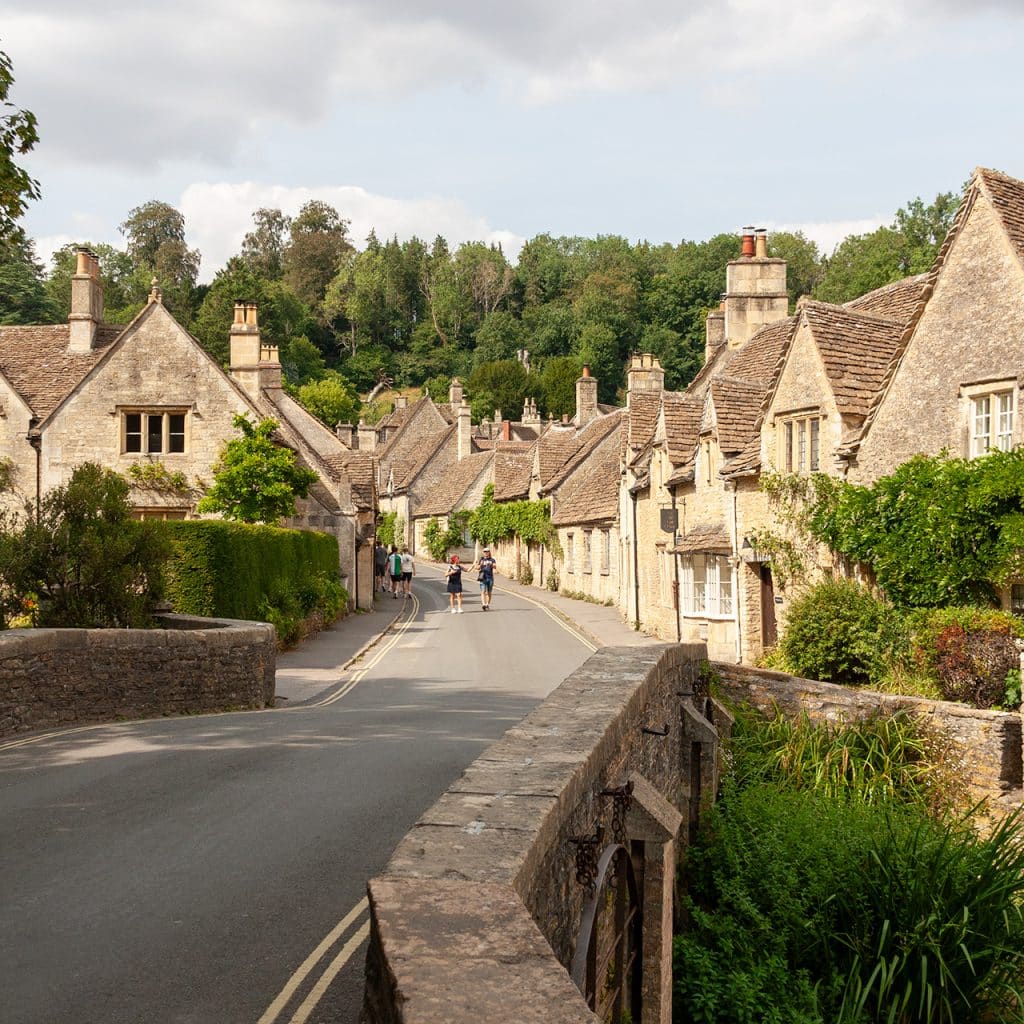
The By Brook is the stream that made the village and it is now the most photographed thing in it. The bridge over it is where most people stop.
Looking for the castle
There isn’t one, and this is the question the parish gets asked most.
There was a castle, about half a mile north west of the Manor House Hotel, on a promontory above the Bybrook valley with steep ground falling away on three sides. Reginald de Dunstanville is credited with building it around 1140, on a spot that had already served as an Iron Age camp and then a Saxon one. It was a motte and bailey, unusual in having a keep and at least four baileys, and the summit it occupied runs to about eight acres. The flat ground behind it is still called the tilting ground.
The keep was still standing at the end of the seventeenth century. Camden’s Britannia says it could be seen from Corsham, five miles off, and John Aubrey describes it “strongly seated on a steep hill”. After that it went. The tower in Victorian drawings of the site is not the castle: a marker tower was put up there in the 1800s to show where it had been, and that is what was demolished in 1950.
What is left is earthworks, a ditch and mound, and some masonry lost in the undergrowth. You cannot go and see it. The site has been a scheduled monument since 1981 and it belongs to the golf club, with no public access.
The Manor House
At the top of the village (not the top of the hill), behind a long drive, is the Manor House, a country house hotel in a building the hotel dates to the fourteenth century, set in 365 acres of gardens and parkland. Its 18-hole championship golf course was designed by Peter Alliss and Clive Clark and opened in 1992.
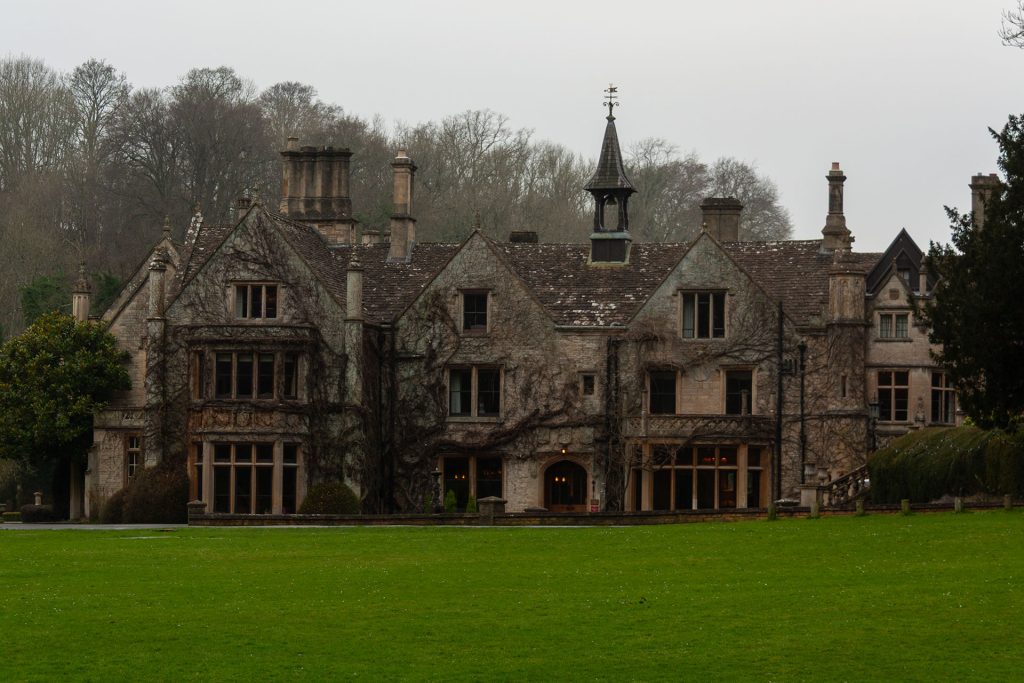
Its restaurant, Bybrook, has a Michelin star, and the pub on the market square in the village below, the Castle Inn, belongs to the same group.
The film locations
Look up and notice what is missing: no telegraph poles, no television aerials, no street lights. The wiring runs underground. That, and the fact nothing new has been built in the old village since about 1600, is why the crews keep coming back.
Doctor Dolittle was filmed here in 1966, with Castle Combe playing the seaport of Puddleby-on-the-Marsh. It did not go well. 20th Century Fox dammed the By Brook to make a harbour, the village objected, and a young Army officer called Ranulph Fiennes, later the explorer and at the time fresh off an explosives course, conspired to blow the dam up. The police got there first. He was fined £300 for conspiring to cause a public mischief and £200 for possessing explosives, and was sent back from the SAS to his old regiment.
Stardust used the village as the town of Wall in 2007, The Wolf Man came in 2010 and Spielberg’s War Horse in 2011. More recently Apple’s Slow Horses shot part of its second series here and at the airfield, calling the village Upshott.
The parish’s line on this is worth quoting: Castle Combe is “a tiny living village, not a film set”.
You can see photos from some of the film sets on display in the church.
Castle Combe Circuit
Just outside the prettiest village in England there is a motor racing circuit.
The airfield opened in May 1941 as RAF Castle Combe, on land belonging to the Castle Combe estate, and closed in 1948. Between 1946 and 1948 the buildings housed Polish ex-service personnel who had nowhere to go home to. The circuit opened in 1950, running on the airfield’s perimeter road, and the first meeting was held on 8 July that year by the Bristol Motorcycle and Light Car Club. In October 1955 it staged the first Avon Trophy, a non-championship Formula One race, won from pole by the American Harry Schell in a Vanwall.
It still runs race meetings and track days. It is a separate place with its own entrance, not something you stumble into from the village.
Where to eat and drink in Castle Combe
The White Hart is the village pub in the ordinary sense of the phrase. Fourteenth century, on the main street, a Wadworth house, so Wiltshire beer on the pumps. There is a courtyard garden at the back and log fires in winter, and it does traditional pub food. This is the one to walk into without a plan.
The Castle Inn stands on the old market square by the Market Cross. The building is twelfth century and it is run by Exclusive Collection, the same company as the Manor House up the hill. Still a pub, with local ales and a fire, but the kitchen holds two AA rosettes and it has twelve rooms upstairs. Worth booking.
Bybrook, the restaurant inside the Manor House, has held a Michelin star since 2017 under Robert Potter. Lunch or dinner, in a fourteenth century room looking onto Italian gardens. Book well ahead.
The Old Stables is the coffee shop, opened in 2017, with a log burner for the cold months and sofas. It says on its own site that muddy dogs and sweaty cyclists are welcome, which tells you the tone.
The Little Picnic Shop, halfway along the main street, sells one thing: an afternoon tea picnic box with a drink, vegetarian as standard. Gluten free, dairy free and vegan boxes need ordering a day ahead. They will also tell you where to go and eat it.
Where to stay in Castle Combe
Staying the night is the answer to the crowds. The day visitors are gone by six and you get the street back.
The Manor House is the country house hotel option, with the golf course and Bybrook. The Castle Inn is the cheaper of the two and puts you on the market square. Just outside the village, the Delkin Shepherd’s Huts are a fire pit and two people sort of arrangement rather than a hotel. There are also B&Bs and self-catering cottages in and around the village.
Getting here and parking
Castle Combe sits just off the B4039. The visitors’ car park is immediately as you turn off the B4039 into the village, and it is pay and display. Put “Castle Combe Visitors Car Park” into your satnav rather than the village name.
The car park is above the village, so you walk down to the village and back up to the car. It is not a long walk, but it is a hill, and it is the thing people underestimate.
Do not try to drive down into the lower village looking for a space. There are 9 parking spaces in the village centre and the parish says they are usually all taken by residents. The lanes are narrow, mostly without pavements, and shared with pedestrians, horses and delivery vans. Coaches are not permitted into the village centre at all and park in the visitors’ car park.
The nearest station is Chippenham, which has buses to the village. If you are working out how to reach the Cotswolds without driving, there is more on getting around without a car and on getting to the Cotswolds.
Public toilets are south of the town bridge, on Water Lane. Walk over the bridge, follow the river on your left, and they are on the right.
Drones
The parish asks people not to fly drones over Castle Combe. It is a conservation area, the village is small enough that a drone is audible in every house in it, and residents have made the request publicly. Whatever your permissions, this one is worth respecting.
When to visit
Weekdays, and spring or autumn rather than August. Bank holidays are the worst of it and the car park fills, with no overflow to fall back on. Early morning and late afternoon are quieter than the middle of the day.
The parish’s own favourite season is winter, which is a fair recommendation: the village does not depend on flowers, and a cold weekday morning gets you the street more or less to yourself.
Places to visit near Castle Combe
Lacock is eight miles or so away, a National Trust village and abbey that has done even more filming than Castle Combe has. Biddestone is two miles away and gets a fraction of the visitors for a village green and a duck pond that are worth the detour. Chippenham is the nearest town and the nearest station. Bath is around twelve miles south west.
Further into the Cotswolds proper, Tetbury is about fifteen miles north, and Cirencester about twenty five. If you are working through the prettiest-village shortlist, Bibury is the other name that always comes up, and it is roughly an hour’s drive north east.
Castle Combe FAQ
Is Castle Combe in the Cotswolds?
Yes. It is in Wiltshire, in the southern part of the Cotswolds National Landscape, built of the same oolitic limestone as the villages further north. Apparently some people disagree but they are wrong.
How long do you need in Castle Combe?
An hour or so covers the village on foot, and the parish’s own figure for the average visit is just over one hour. Book lunch at one of the pubs and you have half a day. If you want more than that, walk one of the footpaths out of the valley or pair it with Lacock or Biddestone.
Is there anywhere to eat in Castle Combe?
More than the size of the place suggests. Two pubs, the White Hart on the main street and the Castle Inn on the market square, plus the Old Stables coffee shop, the Little Picnic Shop for takeaway afternoon tea, and Bybrook, the Michelin-starred restaurant at the Manor House. Book everything except the coffee shop, particularly at weekends.
Can you stay in Castle Combe?
Yes, and it is the best way to see it. The Manor House and the Castle Inn are the two hotels, both run by the same group. There are shepherd’s huts on the edge of the village and B&Bs and self-catering cottages in and around it.
Is Castle Combe or Bibury better?
They are the same argument with different scenery. Castle Combe is one street in a wooded valley with a brook running through it and no shops. Bibury is bigger, has a trout farm, a hotel and Arlington Row, and gets coach traffic Castle Combe does not. Castle Combe is the quieter of the two on a weekday. Neither is quiet in August.
How far is Castle Combe from Bibury?
About 40 miles by road, an hour or so depending on which route you take across the Fosse Way.
How far is Castle Combe from Bath?
About 12 miles, roughly half an hour.
Can you visit Castle Combe castle?
No. The castle is gone, the earthworks are overgrown and the site is on private land belonging to a golf course.
Is there a charge to visit Castle Combe?
No. The village is free to walk around. You pay for parking.
Castle Combe is a place people live, and the cottages on the main street are their houses rather than a set. Do not go into gardens or lean on windowsills for the photograph, and take your rubbish home with you: the parish empties the bins daily when it is busy and they still overflow.
See more Cotswold villages.